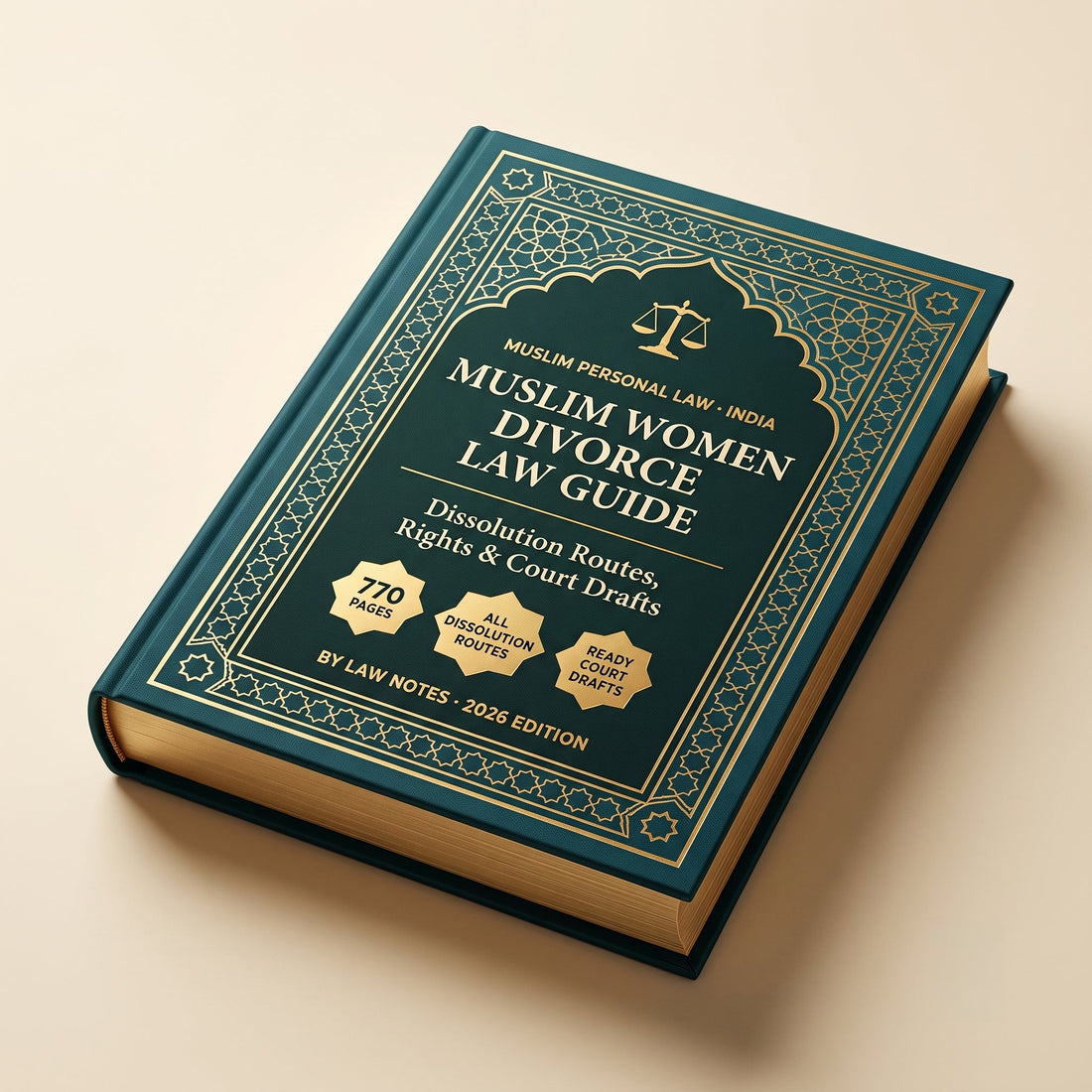
Muslim Women Divorce Law Guide
Every legal route a Muslim woman can use to dissolve a marriage — DMMA grounds, khula, triple-talaq law and maintenance — with ready court drafts.
One-time payment · GST included · lifetime access
A complete, current reference
Everything below is included the moment you buy — no add-ons, no upsells.
- All dissolution routes for Muslim women in one place
- Section-by-section DMMA 1939 grounds explained
- Ready court drafts, intake forms and filing checklists
- Maintenance, mehr and custody guidance
- Hyperlinked PDF — read on any device
- Instant download after purchase
What this guide covers
- Introduction & Legal FrameworkMuslim women's rights to dissolve marriage
- Dissolution under the DMMA 1939All nine grounds under Section 2
- Khula and Mubara'atWife-initiated dissolution
- Ila, Zihar and Li'anSpecial grounds and judicial routes
- Triple Talaq LawMuslim Women (Protection of Rights on Marriage) Act 2019
- Maintenance after DivorceSection 144 BNSS and the 1986 Act
- Mehr (Dower)Nature, quantum, recovery and enforcement
- Custody and GuardianshipChildren after dissolution
- Evidence and ProofIn Muslim dissolution matters
- Jurisdiction & ProcedureCourt selection and procedural requirements
- Restitution, Appeals & ExecutionConjugal rights and enforcement
- Constitutional Framework & UCCContemporary developments
- Domestic Violence & Interim ReliefConciliation and protective orders
- Family-court advocates handling matrimonial dissolution
- Litigants and clinics needing reliable procedure and drafts
- Law students studying Muslim personal law
What readers say
★★★★★ 4.6 · 4Finally understood the basic structure doctrine. The illustrations make it impossible to forget.
Plain English, zero filler — exactly what revision needs. Wish I'd had this in first year.
Great for concepts. Would love a companion volume on landmark judgments next.
Frequently asked questions
Law Notes publishes professional legal reference eBooks for Indian lawyers and law students at lawnotes.shop, spanning criminal law, drafting, case-law digests, civil and family practice, corporate and tax, exam preparation, and rapid-revision guides for Indian legal practice and study.
All Law Notes titles are digital eBooks delivered instantly after purchase. You download and keep your copy and can read it on a laptop, tablet, or phone, with no shipping.
Yes. Law Notes books use the current Indian legal framework, with the Bharatiya Nyaya Sanhita (BNS), Bharatiya Nagarik Suraksha Sanhita (BNSS), and Bharatiya Sakshya Adhiniyam (BSA) replacing the old IPC, CrPC, and Indian Evidence Act references where applicable.
They are written for practising advocates, public prosecutors, defence counsel, junior lawyers, and law students, including judicial-services, PCS-J, and bar examination (AIBE) aspirants, for use in both active practice and exam revision.
The eBooks are clean, professional PDFs that read well on any device and can be searched by keyword. They are laid out for clarity and navigation, not as scanned or image-only files.
Yes. Each title is a digital PDF you can open on a phone, tablet, laptop, or desktop using any standard PDF reader, which makes revising on the go straightforward.
Yes, Law Notes titles are written in clear, professional English throughout.
Law Notes titles carry their edition year (current titles are 2026 editions) and reflect the state of the law at the time of publication. Because legislation and judicial interpretation evolve, they are intended as study and reference aids to be used alongside primary sources.
Yes. Law Notes titles draw on Supreme Court and High Court decisions, presented with their holdings and the principles they establish, using standard Indian citation style so you can trace and verify the authorities.
Yes. Every title is written for the Indian legal system, covering Indian statutes, constitutional provisions, and case law, with particular strength in criminal law and core practice areas.
No. Law Notes books are educational and reference materials, not legal advice. They provide a structured understanding of the law, and readers should verify the current position and consult qualified counsel for any specific matter.
Often read together
![AIBE XXI Fast Track Prep Bundle [June 2026 Edition] Law Notes](http://lawnotes.shop/cdn/shop/files/32.jpg?crop=center&height=600&v=1782504768&width=600)